How Coconut Milk Fudge Creates the Perfect Creamy Texture
Most coconut milk's high fat and emulsifiers give you a silky, creamy mouthfeel, while careful heating and stirring prevent sugar graininess; avoid overheating

This article contains Amazon affiliate links. As an Amazon Associate, CandiesAndSweets earns from qualifying purchases.
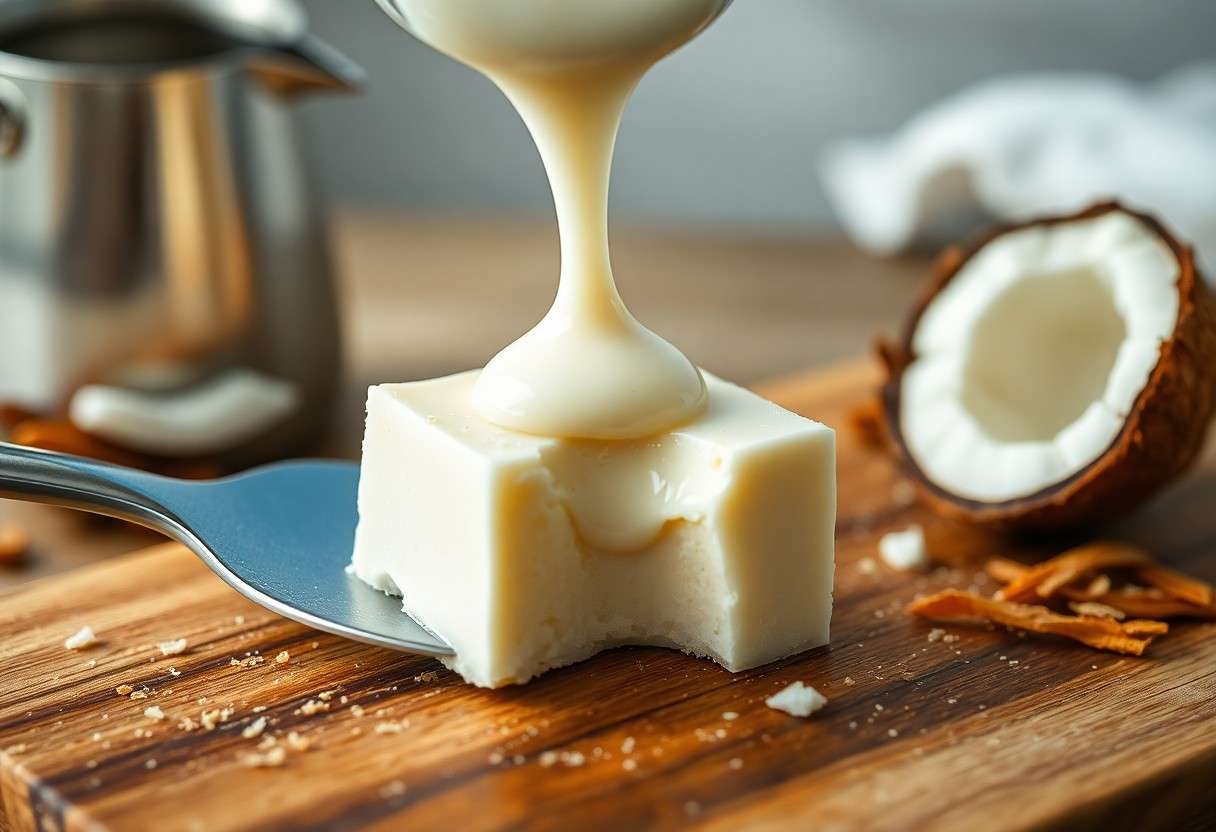
Most coconut milk’s high fat and emulsifiers give you a silky, creamy mouthfeel, while careful heating and stirring prevent sugar graininess; avoid overheating that causes separation, and use slow cooling to set a smooth, glossy finish.
The Molecular Composition of Coconut Milk
Coconut milk contains water, proteins, carbohydrates, and a high proportion of fats, especially medium-chain triglycerides, which shape the way your fudge feels on the tongue. You will notice that the relatively high saturated fat content both enriches creaminess and demands careful handling to avoid greasy separation.
Proteins and soluble solids act as native stabilizers, so you can count on them to trap fat droplets and reduce graininess during cooling. You should expect that variations in extraction and dilution alter droplet interactions and therefore how creamy your finished fudge becomes.
Role of Medium-Chain Triglycerides in Mouthfeel
Medium-chain triglycerides melt at lower temperatures than long-chain fats, which gives you a swift, silky melt that mimics dairy cream. You can recognize that MCTs deliver the signature velvety mouthfeel, enhancing perceived richness without heavy solids.
Natural Emulsification and Fat Globule Distribution
Natural emulsifiers-proteins and phospholipids-coat oil droplets so you can maintain a stable suspension during heating and cooling. You should pay attention to droplet size and distribution because smaller fat globules produce smoother, less grainy fudge, while larger droplets raise the risk of oiling off.
Controlling homogenization and mixing intensity lets you tune fat globule distribution, so you can achieve the ideal balance of firmness and silkiness; over-processing can damage protein films and cause oil separation that undermines texture.
The Science of Sugar Crystallization
Sugar behavior in coconut milk fudge dictates whether you achieve a glossy, silky bar or a grainy one. You control nucleation by managing heat and impurities; prolonged high heat or uneven stirring accelerates crystal growth and risks burning or coarse texture.
Fine adjustments to cooling rate and inclusion of small amounts of invert sugars favor many tiny crystals and a creamy mouthfeel. You should avoid sudden temperature shifts and erratic stirring that allow a few crystals to dominate and produce grit.
Controlling Crystal Size for Velvety Consistency
Temperature stability and timed agitation let you dictate crystal population: steady cooling with measured stirring encourages uniform, tiny crystals, while overheating followed by rapid cooling yields large, gritty crystals. You must monitor the pan to prevent scorching coconut milk solids.
Utilizing Interference Agents to Prevent Graininess
Interference agents like corn syrup, invert sugar, or cream of tartar break sucrose into smaller sugars so you reduce nucleation and maintain a smooth texture. You add them during the boil or early cooling to modulate crystallization without masking coconut flavor.
Practical application calls for modest amounts-typically a few tablespoons per batch-so you achieve fewer visible crystals and a silkier finish; too much addition can make the fudge sticky or overly soft, altering set and mouthfeel.
Thermal Processing and Texture Development
Thermal processing governs how proteins and sugars interact in coconut milk fudge; you control heat to coax fats and sugars into a smooth, cohesive matrix that defines creaminess and mouthfeel. The milk’s fat content helps create a silky texture that depends on precise heat management.
Precision Boiling and the Soft-Ball Stage
Boiling to the soft-ball stage (235-240°F / 113-116°C) concentrates sugars without overcooking; you test by dropping a bit into cold water and observing a pliable ball. You must stir to prevent scorching and watch for burn risk from escaping hot syrup.
Impact of Cooling Rates on Structural Integrity
Rapid cooling traps small sugar crystals, producing a tender, glossy set, whereas slow cooling encourages larger crystals and graininess; you can tune firmness by adjusting cooling speed to protect overall structural integrity.
Controlled cooling-room temperature for the first 10-15 minutes, then refrigeration-helps coconut fat crystallize evenly; you should avoid shocking the fudge with ice baths because sudden contraction causes cracking and weeping.
Optimizing the Fat-to-Solids Ratio
You can tune creaminess by raising the fat proportion while keeping enough solids for structure; higher fat yields a silkier mouthfeel, but you must balance solids so the fudge holds slices and doesn’t collapse.
Aim for a ratio that gives density without runniness and test small batches so you learn the sweet spot; overheating risks separation, so monitor temperature and cool slowly to encourage proper crystallization.
Selecting High-Fat Coconut Creams for Density
Choose full-fat coconut cream so you get a dense, glossy body; full-fat creams produce the richest, creamiest texture. You should avoid “light” varieties because thin milks create watery, grainy results that undermine fudge density.
Balancing Dry Ingredients for Structural Stability
Measure dry ingredients by weight so you consistently control solids; accurate weighing ensures predictable set, and you can tune sugar levels to firm or soften the final bar.
Sift powdered milk and starch to prevent clumps and ensure even distribution; undissolved lumps form weak pockets, so you will get a more uniform, sliceable texture when ingredients are homogeneous.
Adjust dry solids carefully by substituting small portions of powdered milk with tapioca or cornstarch to improve chew, but excess starch yields a gummy mouthfeel, so you should test incremental changes and let the fudge rest overnight for full setting.
Advanced Techniques for Texture Refinement
Techniques here center on tight temperature windows and hands-on handling so you can coax a silky, consistent finish from coconut milk fudge; you prioritize gentle shear during cooling and avoid overheating to prevent emulsion breakdown and grainy texture.
- Mechanical aeration and controlled agitation
- Tempering and slow, staged cooling
- Seeding and crystal-size management
Method Comparison
| Method | Primary Effect |
|---|---|
| Agitation control | Smooths microstructure, reduces lumps |
| Tempering | Stabilizes emulsion and small crystals |
| Seeding | Encourages uniform crystal formation |
Mechanical Aeration and Agitation Methods
Aeration techniques require you to use low-speed paddles or gentle folding so trapped air is minimized and over-aerating causes graininess; you should time agitation to begin once the syrup has cooled to a warm stage to encourage fine, uniform crystals and a dense, creamy mouthfeel.
Tempering for Long-Term Smoothness Retention
Tempering asks you to cool the batch slowly to a warm, hand-hot range before light agitation, then hold at a stable temperature so seeds form; rapid cooling creates large crystals and a gritty texture, while careful seeding preserves long-term smoothness.
Control your post-temper hold by keeping the fudge in a mildly warm environment and avoiding repeated high heat cycles; you can use gentle, brief reheats only if the emulsion stays intact, because overheating will break the coconut milk emulsion and ruin the silky finish.
Final Words
Summing up, you get glossy, silky fudge because coconut milk’s high fat content and emulsifying properties bind sugar and cocoa while slow cooking concentrates solids, giving a dense yet creamy mouthfeel. Your technique-stirring, temperature control, and cooling-determines crystal size and smoothness, so you should reduce agitation and use gentle heat. Small amounts of added fat or invert sugar further suppress crystallization, and chill timing sets texture without graininess.


