The Complete Guide to Functional Ingredients in Candy
There's a concise guide to help you identify functional ingredients in candy so you can weigh benefits against risks like allergens and excess sugar, understand

This article contains Amazon affiliate links. As an Amazon Associate, CandiesAndSweets earns from qualifying purchases.
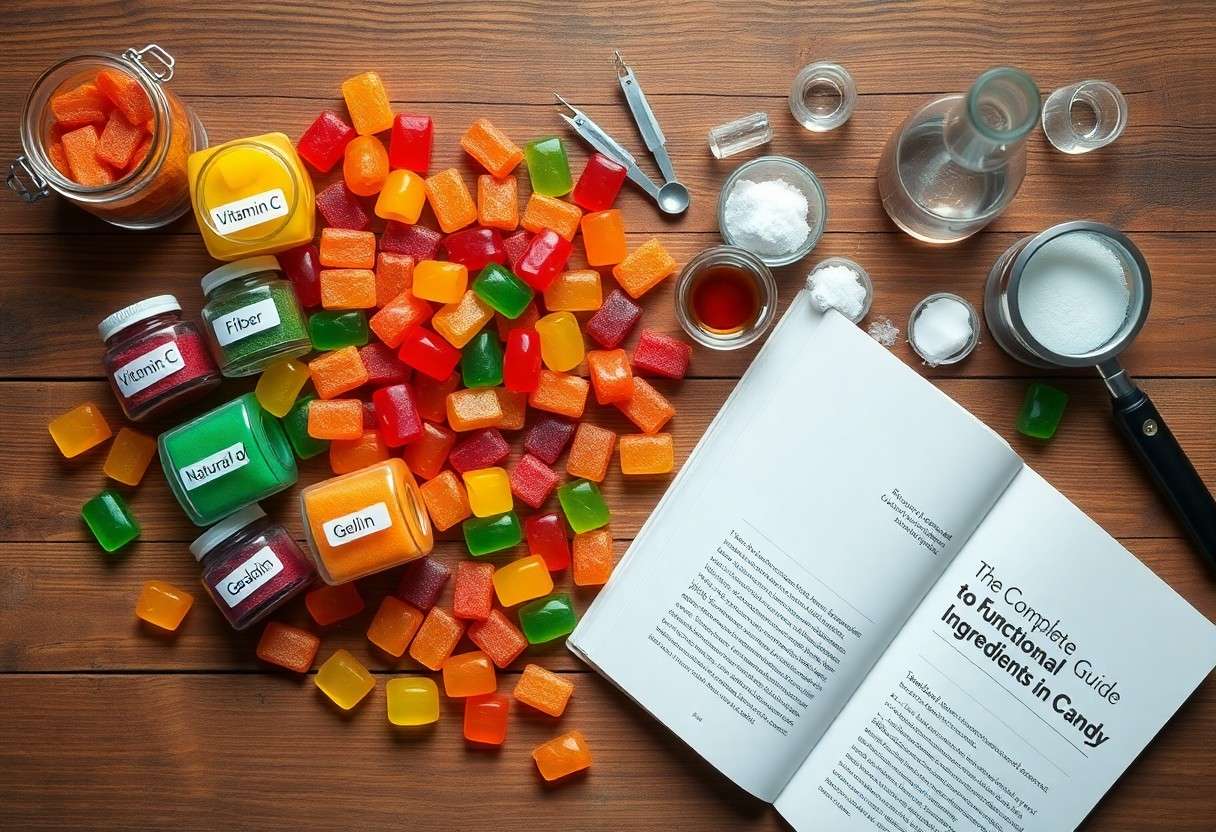
There’s a concise guide to help you identify functional ingredients in candy so you can weigh benefits against risks like allergens and excess sugar, understand dosage and regulation, and spot vitamins, fiber, and probiotics that add value.
Critical Factors in Ingredient Selection
Selection asks you to weigh safety, potency, taste and shelf stability when choosing functional ingredients for candy.
Balance testing should cover solubility, interactions and sensory impact; consider
- Bioavailability
- Stability
- Sensory impact
- Toxicity
Assume that you will prioritize trials exposing off-target effects and shelf-life losses.
Bioavailability and Therapeutic Efficacy
Absorption determines how much active reaches your system; the candy matrix can reduce efficacy so you must test release and metabolic stability.
Regulatory Compliance and Labeling Standards
Compliance requires you to verify approvals, maximum dosages and permitted claims; failure can cause recalls and fines, so maintain documentation.
Labels must list active amounts, allergen warnings and truthful claims; you should retain batch records and analytical evidence to support any label statements.
Step-by-Step Integration in Manufacturing
| Step | Key Considerations |
|---|---|
| Ingredient selection | Match thermal tolerance and solubility; prefer coated or encapsulated forms for heat-sensitive actives |
| Pre-blending | Use carriers and anti-caking agents to stabilize microdoses and reduce segregation |
| Cooking profile | Control temperature, time, and vacuum to limit degradation and preserve functionality |
| Mixing & dispersion | Adjust shear, order of addition, and fill fraction to achieve uniform distribution |
| Quality checks | Implement in-process sampling, assay targets, and lot release criteria |
Managing Thermal Stability During Cooking
Heat control helps you preserve functional activity by targeting narrow processing windows for sensitive actives. Monitor temperature and time to avoid bioactivity loss and off-flavors, and apply vacuum or staged cooking to reduce thermal exposure. Cooling profiles influence final texture and ingredient integrity.
Achieving Homogeneous Ingredient Distribution
Mixing strategies help you maintain consistent dosing by addressing particle size and density differences; pre-blends with carriers reduce segregation risk. Choose mixers and feed rates that limit dead zones and use periodic sampling to detect uneven pockets before enrobing or molding.
Shear settings allow you to disperse actives without overheating; balance speed to break agglomerates while preserving functionality. Inline dispersion and controlled addition points improve particle wetting and support uniform mouthfeel.
Sampling protocols enable you to verify homogeneity across a batch; spatially distributed samples and simple assays reveal segregation trends quickly. During scale-up, adjust residence time and mixer load to retain the same distribution profile and confirm with lot-level assays.
Pros and Cons of Functional Confections
| Pros | Cons |
|---|---|
| Product differentiation and premium margins | Regulatory scrutiny and complex claim substantiation |
| Access to health-focused consumer segments | Higher ingredient and testing costs |
| Opportunities for repeat purchases and brand loyalty | Risk of consumer distrust from overpromising |
| Innovation in formats and delivery mechanisms | Formulation challenges affecting texture and taste |
| Potential for partnerships with health brands | Shelf-life and stability limitations |
| Marketing stories based on functional science | Need for clinical or bioavailability evidence |
| Flexibility to target niches (sleep, focus, immunity) | Labeling complexity and allergen management |
| Consumer willingness to pay for perceived benefits | Possible safety limits and dosing restrictions |
Market Differentiation and Consumer Appeal
Brands can use functional ingredients to stand out on shelf and online, so you should design packaging and claims that match the benefit and audience. You will increase conversion when you combine taste-first development with credible science and transparent sourcing to build trust and justify higher price points.
Consumers expect enjoyable flavor alongside benefit, so you must balance sensory quality with efficacy. You will lose buyers quickly if the confection tastes poor or if claims appear unverified; clear labeling and third-party validation support sustained adoption.
Formulation Complexity and Sensory Challenges
Formulators face ingredient interactions, stability constraints and dosage safety considerations that change processing and cost, so you must plan for compatibility testing early. You will need to assess pH, water activity and thermal sensitivity to protect function and shelf life.
Textures often shift when you add fibers, proteins or oils, and masking off-flavors typically requires encapsulation, flavor adjustments or alternative carriers. You should run iterative sensory trials to retain mouthfeel and palatability without compromising efficacy.
Testing at lab and pilot scale confirms bioavailability, release profiles and stability; you should perform accelerated shelf tests and blind sensory panels to catch failures before scale-up. You must also engage regulatory review to avoid noncompliance and support any label claims.
Expert Tips for Product Stability
You should prioritize ingredient selection and process controls to preserve functional ingredients and ensure product stability. Keep heat and moisture limited to avoid degradation and microbial risk; choose mild processing and protective excipients to protect bioactives.
- pH control for enzyme and vitamin stability
- Encapsulation to shield actives from oxygen and taste
- Oxygen barrier films and desiccants to prevent oxidation
Effective Flavor Masking Techniques
Using micro-encapsulation, sweetener blends, and inclusion complexes lets you mask off-notes from functional ingredients while retaining intended flavor. Test small-batch prototypes to tune intensity and avoid bitterness from high-potency actives.
Optimized Packaging for Nutrient Retention
Packaging choice must reflect the sensitivity of the payload: select films with proven oxygen barriers, UV protection, and moisture control to maximize nutrient retention. Validate through accelerated shelf-life studies and monitor headspace oxygen levels.
Knowing how packaging interacts with transport and storage conditions lets you set realistic tolerances, specify protective inserts, and document protocols that preserve potency and product stability.
Conclusion
Considering all points, you can apply functional ingredients to balance taste, texture, and health claims while complying with regulations and clear labeling.
You should prioritize ingredient interactions, rigorous testing, and transparent communication to create safe, appealing candy that meets consumer expectations.


