The Incredible Story of Rock Candy
Many sweet lovers may not know the fascinating history behind rock candy, a delightful treat enjoyed by people of all ages. This unique confectionery, with its

This article contains Amazon affiliate links. As an Amazon Associate, CandiesAndSweets earns from qualifying purchases.
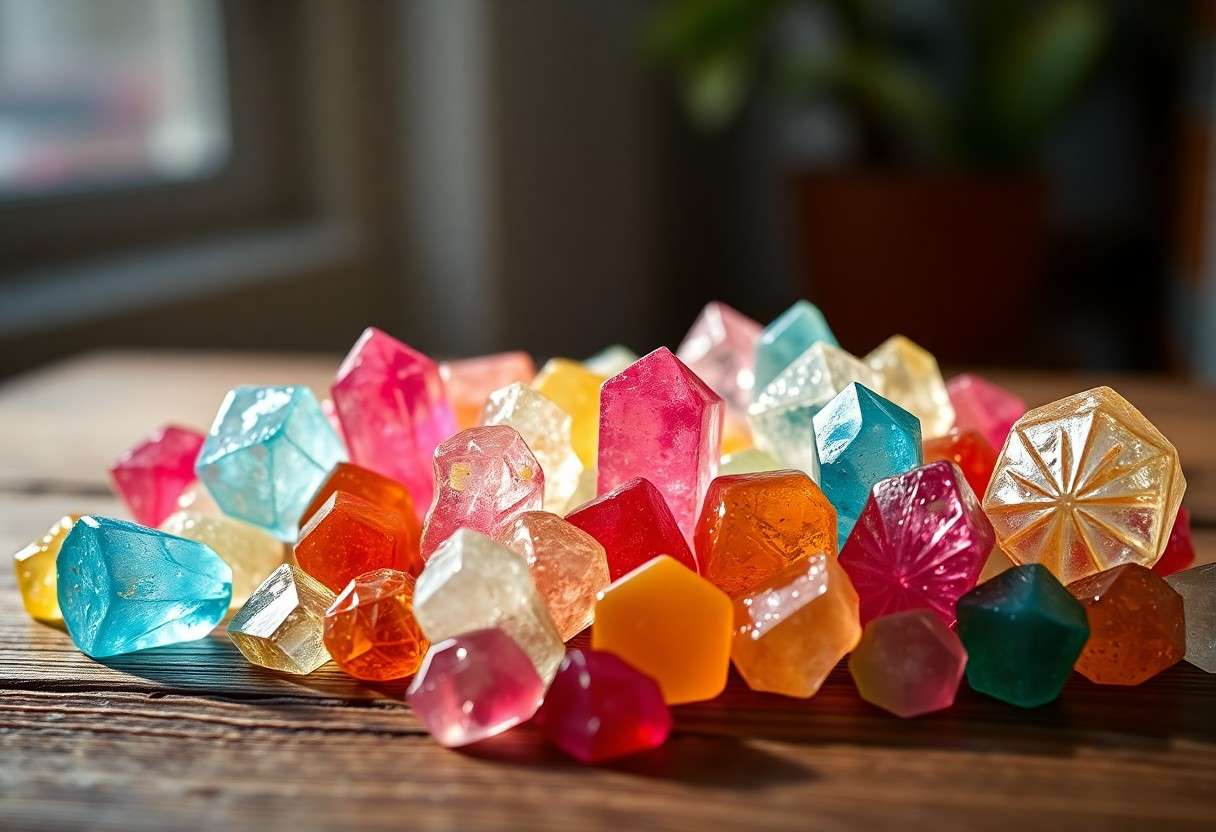
Many sweet lovers may not know the fascinating history behind rock candy, a delightful treat enjoyed by people of all ages. This unique confectionery, with its striking crystal formations, has a story that spans cultures and centuries. As you research into its origins, preparation methods, and the science behind its creation, you will uncover the reasons behind its enduring popularity and charm. Get ready to explore the captivating journey of rock candy and how it has become a staple in the world of sweets.
The Ancient Origins of Sugar Crystallization
Sweet Discoveries in Ancient Civilizations
Throughout history, civilizations have been captivated by the allure of sweetness. The earliest evidence of sugar’s crystallization dates back to around 500 AD in India, where sugarcanes were cultivated and processed into a form of granulated sugar known as ‘khanda’—the precursor to the sugar you might use in your kitchen today. Ancient Indians discovered that by boiling sugarcane juice, they could extract sugar crystals, leading to innovations not only in cooking but also in medicinal applications. This knowledge soon spread, influencing various cultures across the globe, including the Persians and eventually the Arabs, who further refined the methods of producing sugar crystals.
In China, evidence from the Tang Dynasty indicates that the art of crystallizing sugar reached the East as well. Your ancestors navigated trade routes, facilitating cultural exchanges that brought exotic spices and sweeteners to the forefront of culinary experiences. Sweetness became intertwined with ceremonies and social gatherings, symbolizing wealth and hospitality. It’s fascinating to consider how these early innovations paved the way for the sugar industry and laid the groundwork for delights like rock candy.
The Alchemy of Sugar and Water
The process of crystallization, which transforms liquid sugar syrup into those beautiful rock candy crystals, is as much science as it is art. When you dissolve sugar in water, you’re creating a saturated solution—at a certain temperature and concentration, the water holds as much sugar as it can. Upon cooling, this solution becomes unstable, prompting sugar molecules to begin crystallizing. By carefully manipulating temperature and concentration, you can encourage larger crystals to form, resulting in the striking, glistening formations of rock candy.
Every aspect of this process directly impacts the size and quality of your crystals. The purity of the sugar, the speed at which you cool the solution, and even the vessel you use can all yield different results. Your experiments with crystallization might surprise you: taking note of these variables can lead to delicious and visually stunning outcomes. In essence, you’re not just making candy; you’re engaging in a sweet form of chemistry that has its roots in those ancient practices that transformed simple sugar into a delicious craft.
Crafting the Perfect Rock Candy
Essential Ingredients and Their Roles
Creating rock candy revolves around a simple blend of key ingredients that play distinct roles in achieving that signature crystalline texture. The primary component is granulated sugar, which forms the majority of your candy’s structure and sweetness. Water acts as the solvent, enabling the sugar to dissolve and later crystallize. Adding a dash of corn syrup prevents the formation of unwanted sugar crystals, ensuring that your final product is smooth and glossy. For flavoring and color, you can introduce food coloring and extracts, like vanilla or peppermint, which can turn your rock candy into a feast for both the eyes and taste buds.
| Ingredient | Role |
|---|---|
| Granulated Sugar | Forms the base and sweetness of the candy. |
| Water | Acts as a solvent for dissolving sugar. |
| Corn Syrup | Prevents unwanted crystallization. |
| Food Coloring/Extracts | Adds flavor and visual appeal. |
The Step-by-Step Process of Creation
Crafting rock candy is a blend of patience and technique, beginning with creating a supersaturated sugar solution. You start by boiling equal parts water and sugar, then introducing corn syrup and any desired flavors. Once the mixture is thoroughly combined and the sugar fully dissolved, it’s not quite ready yet. You’ll need to let the solution cool before pouring it into a clean glass jar where your stick will be placed. Secure the stick in the jar so it hangs suspended, allowing for the sugar to crystallize around it during the cooling process. Over several days, you will witness the delightful transformation as sugar crystals form around the stick.
| Step | Description |
|---|---|
| 1. Make the Sugar Solution | Boil water and sugar, add corn syrup and flavoring. |
| 2. Cool the Mixture | Let the boiled mixture cool before pouring into a jar. |
| 3. Prepare the Stick | Place a clean stick in the jar, ensuring it’s suspended. |
| 4. Wait for Crystallization | Allow the candy to sit undisturbed for several days to form crystals. |
Patience is key in the final stages of crafting your rock candy. After setting up the stick in the jar with your supersaturated solution, it’s a waiting game. Optimal conditions, such as temperature and humidity, will affect how quickly crystals form, but typically, within 7 to 10 days, you’ll see beautiful, sparkling sugar formations adorning your stick. Once crystallization is complete, carefully remove the candy, rinse off excess sugar, and allow it to dry. This sweet reward will be more than just a treat; it’s a testament to your craft and a delightful treat to enjoy or gift to others.
The Chemistry Behind Crystals
Nucleation: The Birth of Crystals
Nucleation marks the first step in crystal formation, where the process begins with the arrangement of molecules into a structured pattern. This process can occur spontaneously in a supersaturated solution, where the concentration of sugar exceeds the solubility limit. As the solution cools, tiny clusters of sugar molecules start to form, acting as seeds for larger crystal growth. Initially, these clusters are unstable, but as more sugar molecules attach to them, they grow into visible crystals, forming the iconic shapes of rock candy you see today.
There are two types of nucleation: homogeneous and heterogeneous. Homogeneous nucleation occurs when crystals form uniformly throughout the solution, typically in pure environments. On the other hand, heterogeneous nucleation happens at surfaces or impurities, providing a more favorable environment for crystals to form. This is often observed in homemade rock candy, where the presence of a stick or string acts as a nucleation site, facilitating the growth of larger, more defined crystals.
Factors Influencing Crystal Growth
Your rock candy’s crystal structure isn’t solely dependent on sugar and water; several factors influence how well and how quickly crystals develop. Temperature is a major player; as the temperature of your sugar solution decreases, the solubility of sugar declines, leading to more molecules crystallizing out of the solution. The rate at which the solution cools can also impact crystal size; slower cooling typically yields larger, more uniform crystals, while rapid cooling can result in smaller, more chaotic formations.
Concentration plays a vital role as well. A higher concentration of sugar in the solution can increase the rate of nucleation, giving rise to more crystals. Conversely, if your solution is too saturated, you might end up with a gummy mixture instead of individual crystals. Environmental factors, such as humidity and air movement, can also affect crystal growth by influencing how quickly the solution evaporates or cools. For successful crystal cultivation, those aspects need to be carefully controlled.
- Temperature: Lower temperatures promote crystallization, while higher temperatures prevent it.
- Concentration: A well-balanced sugar concentration encourages crystal growth.
- Cooling Rate: Gradual cooling yields larger crystals; rapid cooling creates smaller formations.
Perceiving how these variables interact allows you to fine-tune your method to produce the perfect rock candy.
- Nucleation Sites: Introducing surfaces for crystals to adhere to can enhance growth.
- Impurities: Some impurities can stimulate better crystallization by acting as anchors for sugar molecules.
- Evaporation: Controlled evaporation of the solution can lead to ideal crystallization conditions.
Perceiving these factors not only enhances your understanding of crystallization chemistry but also empowers you to experiment confidently in your own rock candy creations, leading to satisfying and successful results. Enjoy the scientific art of candy creation!
Cultural Significance and Symbolism of Rock Candy
Rock Candy in Celebrations and Traditions
Rock candy has long been intertwined with a myriad of celebrations and traditions across cultures. In many societies, this crystalline treat is synonymous with joy and festivity. For instance, during weddings in India, it is traditional to offer guests a variety of sweets, including rock candy, known locally as “misri.” This practice symbolizes sweetness in the newlywed couple’s life, celebrating their union with joy and prosperity. You might also find rock candy featured prominently during festivals such as Diwali or Christmas, where its sparkling appearance mirrors the festive lights and decorations that encircle these grand occasions.
In the United States, rock candy features prominently in celebrations ranging from birthday parties to Halloween. It serves as both a decorative element and a delicious treat. Often found on candy buffets or as a colorful addition to party favors, rock candy instills a sense of nostalgia, harkening back to simpler times. Whether used to enhance the decor of a winter wonderland theme or offered as a sweet treat during summer fairs, its presence is a symbol of good times and sweet memories shared among friends and family.
Representations in Literature and Art
Rock candy has made its mark in literature and art, symbolizing everything from innocence to indulgence. Its crystalline structure is often employed as a metaphor for fragility and beauty in various literary works. For example, in children’s literature, rock candy frequently appears as a magical element in fairy tales, enchanting characters and serving as a treat that embodies the joys of childhood. Artists have also drawn inspiration from its vibrant, colorful facets, creating stunning still-life paintings that celebrate the allure of confections and capture the imagination of viewers.
In contemporary art, the crystal formations of rock candy can reflect the transient nature of life, with artists using them to explore themes of decadence and ephemerality. This duality is further highlighted in visual media and film, where rock candy can symbolize fleeting moments of happiness amidst darker themes. You might find scenes where characters savor rock candy, utilizing its vibrant colors and delicate textures to evoke emotions, which makes it not just a treat but an emblem of life’s sweetest—yet sometimes fleeting—experiences.
Innovative Uses Beyond Dessert
Rock Candy in Modern Gastronomy
The versatility of rock candy extends far beyond traditional desserts. Chefs are incorporating it into savory dishes, embracing its contrasting textures and natural sweetness. Incorporating rock candy into sauces can elevate your dish; for example, a basil-infused rock candy glaze drizzled over roasted vegetables can create a surprising yet delightful balance of flavors. Additionally, you might find rock candy incorporated into gourmet cheeses, where the sweetness helps to counteract the saltiness, creating an unexpected harmony on your palate.
This approach not only enhances the aesthetic appeal of your meal but also provides a unique finishing touch that combats the ordinary. Some high-end restaurants even craft their own artisanal rock candy in various flavors, which they then use to create bespoke dishes that captivate guests. Imagine a beautifully plated dessert topped with a custom-flavored rock candy, adding both visual intrigue and a burst of flavor that lingers on your tongue.
Creative Applications in Beverages and Cocktails
You might be surprised to discover how rock candy has found its place in the world of mixology. Bartenders are starting to use rock candy not only as a garnish but also to infuse flavors into cocktails. Crushed rock candy can be added to citrus-based drinks for a burst of sweetness or even melted and incorporated into syrups for a unique cocktail base. Incorporating rock candy into a classic cocktail like a whiskey sour could transform it into an entirely new experience, enhancing the sweetness without the refinement of sugar.
Different flavor profiles of rock candy—think lavender, hibiscus, or chai spice—allow for exciting pairings that can elevate your drinking experience. One popular cocktail trend involves using rock candy as stir sticks, where the candy slowly dissolves while you sip, gradually infusing the drink with a hint of sweetness. The colorful presence of rock candy can also play up the visual appeal of a cocktail, inviting curiosity and enticing guests to try something new.
Experimenting with rock candy in beverages has sparked creativity across the cocktail landscape. From whimsical rock candy martinis to refreshing lemonade with a retro twist, creative bartenders are redefining how we enjoy our drinks. By using rock candy as an ingredient, bars are attracting adventurous patrons who are eager for new taste experiences and presentations, ensuring that your next cocktail outing or home gathering will be a delightful fusion of flavors and fun.
Summing up
To wrap up, the incredible story of rock candy is not just about a sweet treat; it encompasses a fascinating journey through science and culture. As you explore the simple yet intricate process of crystallization, you gain insight into chemistry while enjoying a delicious reward. This age-old confectionery can ignite your curiosity about how everyday items have rich histories and origins. By making rock candy in your own kitchen, you are not only indulging in a delightful experience but also engaging with the principles of nature.
Your journey into the world of rock candy can inspire you to experiment further in your culinary adventures. Whether you’re enjoying it as a nostalgic treat or using it for special occasions, rock candy serves as a reminder of the beautiful interplay between science and art in cooking. So, the next time you savor a piece of rock candy, take a moment to appreciate the elaborate processes and rich stories that transform simple ingredients into a beloved confection.


